 Book now
Giotto's frescoes in the Scrovegni Chapel, story by story
Fifteen minutes, every wall painted. Where to look first, which scenes to find by name, and how the whole room reads from vault to door.
You get 15 minutes inside the Scrovegni Chapel, and Giotto and his team painted every surface of it. That is a lot of painting for a quarter of an hour, so it pays to arrive knowing where to look. This guide takes you round the room in the order we would look at it ourselves: up at the starry vault, along the tiers of stories, into a handful of scenes worth finding by name, down to the grey Vices and Virtues, and finally back to the Last Judgement over the door. It ends with a minute-by-minute plan you can keep on your phone for the waiting room.
Look up first: the blue vault and its roundels
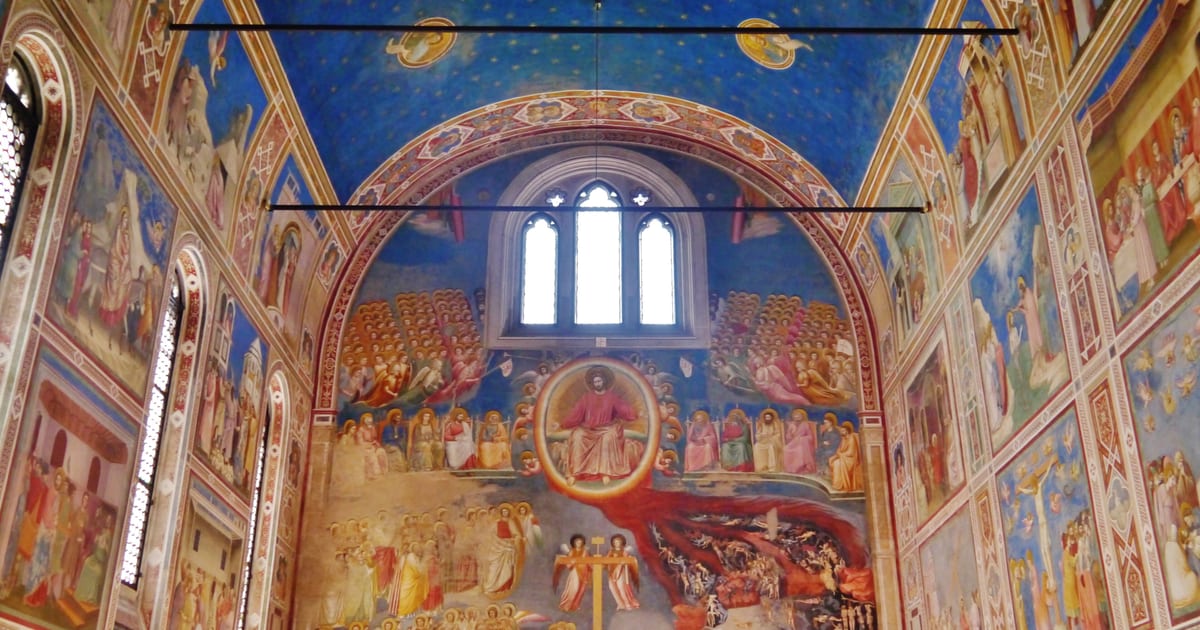
Before you look at a single story, look up. The barrel vault is painted as a deep blue sky scattered with eight-pointed stars. The chapel's own description calls it a blue mantle of stars. Set into that sky are painted roundels. Two show Christ and the Madonna and Child. The others hold seven Old Testament prophets and John the Baptist.
Wikipedia's account of the chapel reads the ceiling as the eighth day, the time of eternity: the prophets are planets, and Christ and the Virgin are two suns. You do not need the theology to feel it. The blue sets the key for the whole room, and it is the colour most people remember.
Give it a full minute, then notice that the blue is not even everywhere. Much of Giotto's ultramarine was laid on dry plaster rather than wet, so it has flaked away faster than the other colours over seven centuries. That is why some skies in the scenes below look patchy or greyish. Nothing is wrong with your eyes.
How the story reads: four tiers, starting on the arch
The chapel is a single room, just under 21 metres long and about 8.4 metres wide, so you can take in almost everything from the middle. Giotto organised the walls in four tiers, with 38 narrative panels telling the stories of Mary and Christ. Stand facing the altar. The wall on your right, with the tall windows, is the south wall. The wall on your left is the north wall.
The story starts high on the triumphal arch above the altar, with an unusual scene: God the Father sending the Archangel Gabriel to Mary. It then runs along the top tier of the south wall with Joachim and Anna, the Virgin's parents, and continues on the top tier of the north wall with the Virgin's early life. Back on the arch come the Annunciation, Gabriel on one side and Mary on the other, with the Visitation and Judas being paid for his betrayal also painted there. The middle tier on both walls tells Christ's childhood and ministry. The lower tier shows the Passion and Resurrection, ending with Pentecost on the north wall. Below that, at ground level, are the Vices and Virtues.
Read each tier from left to right. Christ is mostly shown in profile, and his eyes point continuously to the right, which seems designed to pull you on to the next episode. If you lose your place, find him and follow his gaze.
Meeting at the Golden Gate and the Massacre of the Innocents
Start on the top tier of the south wall. The first panels tell how Joachim is driven out of the temple, takes shelter among shepherds, and how an angel tells Anna she will be a mother. In the sixth panel the couple meet at the Golden Gate of Jerusalem and kiss. The chapel's own text picks out the tenderness of this kiss as an example of Giotto's new attention to human feeling. Look at how close their faces are, and how their bodies lean into one another.
Drop to the middle tier of the same wall for the Massacre of the Innocents. The chapel singles out the despair of the mothers in tears, and once you see them you will not forget them. Then look for the soldier dragging a baby from its screaming mother. Giotto painted him with his head pulled down into his shoulders and an expression of shame. Even the killer is allowed to feel something. It is one of the hardest images in the room, and one of the most human.
The Kiss of Judas and the Lamentation
On the lower tier of the south wall, find the Kiss of Judas. It is easy to spot: Judas's broad yellow cloak wraps around Jesus as he leans in. Their eyes lock, still and intent, while the crowd around them bristles with lances, staves and torches. Judas, calm and young in the earlier scenes, now has a coarse, almost animal face, and he has lost his halo. Look again and you will find Peter cutting off the ear of Malchus, the high priest's servant, and a man blowing a horn on the right.
On the lower tier of the north wall is the Lamentation, often called the most dramatic scene in the cycle. Christ lies low on the left. The Virgin holds him and brings her face right up to his. Mary Magdalene cradles his feet. Saint John bends forward and flings his arms back. A bare rock ridge runs diagonally down the picture and steers your eye straight to the two faces. Above, angels twist in grief, and a small tree at the top right is dead.
Notice the two figures in the foreground with their backs to you. They are solid masses, sitting in real space between you and the body. Italian Wikipedia notes that this scene, freed from Byzantine stiffness, became a model for generations of later painters.
The Vices and Virtues on the lower walls
Most people walk straight past the bottom of the walls. Do not. Giotto painted 14 figures here in grisaille, a monochrome grey made to look like marble statues, each in a mirror-like marble frame with its Latin name written above. The Virtues are on the south wall: Prudence, Fortitude, Temperance, Justice, Faith, Charity and Hope. The Vices face them on the north wall: Folly, Inconstancy, Wrath, Injustice, Infidelity, Envy and Despair.
Look at them in pairs across the room. Justice and Injustice face each other at the exact middle of the chapel. Inconstancy is a young woman tipping off a ball. Charity crushes a money bag under her feet, while across the room red flames burn under Envy. Then follow the walls towards the entrance: as you face the Last Judgement, the Virtues' wall leads to the side of the blessed and the Vices' wall leads to Hell.
The Last Judgement and Enrico Scrovegni's model
Now turn round. Above the entrance door, around a three-light window, the Last Judgement fills the whole west wall. Christ sits at the centre in a rainbow-edged mandorla held by angels, with the twelve apostles enthroned in a semicircle and crowded ranks of angels above. At the very top, two angels peel back and roll up the sky like heavy wallpaper, revealing the jewelled golden walls of the heavenly Jerusalem behind it.
Below, a cross held by two angels divides the wall. The blessed are on the left as you look. Hell is on the right, where fire pours from Christ's mandorla into rivers that drag the damned down. Look for the usurers with white bags of money tied round their necks, and for Judas, hanged. Giotto pulled Judgement, Paradise and Hell into one shared space rather than stacking them in separate bands, as older versions did.
Low on the side of the blessed is the chapel's patron, Enrico Scrovegni. With a second figure, possibly a canon of Padua Cathedral, he offers a model of the chapel to the Virgin, who stands with Saint John and Saint Catherine of Alexandria. Compare the model with the room you are standing in: it shows a grander apse end than the one you see today. Wikipedia records that Enrico meant the apse to hold his tomb.
Giovanni Pisano's Madonna, and the Crucifix that moved
Walk your eyes back up the room to the presbytery, the space beyond the triumphal arch. Here the chapel keeps a sculpture group by Giovanni Pisano, the Madonna and Child between two angels, carved in the early 1300s. After so much painted space, the carved marble is a quiet change of pace, and it is worth a minute of your time.
One thing you will not see is Giotto's painted Crucifix. It once hung in the chapel and is now in the Musei Civici Eremitani, a short walk away in the former Eremitani friars' convent. Every fare we sell includes the Eremitani museums, so plan time there after your slot to see it up close.
Why Giotto mattered: space, weight and feeling
The chapel's own text names two revolutions. The first is space: Giotto shows depth and perspective that anticipate Renaissance theory by a hundred years. The second is people, painted with real physical presence and real emotion. Its examples are the two you have already found: the kiss at the Golden Gate and the weeping mothers in the Massacre of the Innocents.
Wikipedia's Giotto article puts it the same way. His figures are solidly three-dimensional and do not follow Byzantine models, and his way of painting the human face and emotion set him apart from his contemporaries. It calls the Scrovegni frescoes one of the supreme masterpieces of the Early Renaissance. In 2021 the chapel became part of the UNESCO World Heritage site of Padua's fourteenth-century fresco cycles.
It also helps to know the scale of the job. Giotto was in his mid-thirties, working with a team of about 40 collaborators, and the painting took an estimated 625 working days of fresh plaster. The chapel's own text says the cycle was painted in about two years, between 1303 and 1305.
Enrico, his father Reginaldo and Dante's Inferno
Enrico Scrovegni was a wealthy Paduan banker. On 6 February 1300 he bought land beside the site of the old Roman arena, which is why the building is also called the Arena Chapel. He built a palace there with this chapel attached, as a private family oratory and a funerary monument for himself and his wife. The chapel was dedicated to Santa Maria della Carità on 25 March 1303 and consecrated on 25 March 1305.
His father, Reginaldo, has a less flattering place in literature. Dante put him among the usurers in canto XVII of the Inferno. A long tradition says Enrico's offering on the Last Judgement wall was meant to wash away the family's sin of usury, and it is hard not to think of it when you see the usurers with their money bags in Hell. Not every scholar agrees. Giuliano Pisani points out that Dante's canto dates from a few years after the chapel was finished, so it cannot have been the motive. Enjoy the story, and hold it lightly.
A 15-minute looking plan
Before you go in: collect your ticket at the ticket office of the Musei Civici agli Eremitani, Piazza Eremitani 8, about 100 metres from the chapel, at least 30 minutes before your slot. Be at the chapel's entrance pavilion at least 5 minutes before your slot. Late arrival means no entry. You then spend 15 minutes in a climate-controlled waiting room in a group of no more than 25, which is a good moment to reread this plan. Bags go in the cloakroom or lockers, and photos for personal use are allowed without flash.
Minutes 0 to 2: stand in the middle and look up at the vault. Minutes 2 to 4: face the altar and read the triumphal arch, God sending Gabriel, then the Annunciation. Minutes 4 to 6: the top tier on your right, ending at the Golden Gate. Minutes 6 to 9: the Massacre of the Innocents and the Kiss of Judas on the same wall, then the Lamentation opposite. Minutes 9 to 11: the Vices and Virtues at ground level, starting with Justice and Injustice in the middle. Minute 11 to 12: the Pisano Madonna in the presbytery.
Minutes 12 to 15: turn round and give the Last Judgement your last three minutes. Find Christ in his mandorla, the angels rolling up the sky, Hell with its usurers, and Enrico offering his model. Then cross to the Eremitani for Giotto's Crucifix while the room is still fresh in your mind.
Frequently asked
How long do you get inside the Scrovegni Chapel?
Fifteen minutes. Before that you wait 15 minutes in a climate-controlled room that stabilises the chapel's microclimate, so the whole visit takes about half an hour. Each slot takes a maximum of 25 people.
Which frescoes should I see if I only have a few minutes?
The starry vault, the Meeting at the Golden Gate, the Massacre of the Innocents, the Kiss of Judas, the Lamentation and the Last Judgement on the entrance wall. Our 15-minute plan above covers all of them in walking order.
Can I take photos of the frescoes?
Yes, for personal use. Flash, lights, tripods and other equipment are not allowed, and nothing may be touched. Keep your phone on silent.
Where is Giotto's Crucifix?
The painted Crucifix that once hung in the chapel is now in the Musei Civici Eremitani, a short walk from the chapel. Every fare we sell includes the Eremitani museums, so you can see it on the same day.
Which tickets can I book with you?
Adult (18+), EU visitors 65+ (EU citizens over 65, ID shown), Ages 6–17 and Students (valid student card, university and academy students of any age). Each is a timed entry for one 15-minute slot and includes the Musei Civici Eremitani, plus Palazzo Zuckermann Tuesday to Sunday. Children up to 5 go free and we add them to your booking at no charge. Tickets are non-refundable, cannot be changed in date or time, and cannot be booked for the same day. Your e-ticket arrives by email.
Is the chapel open all year?
It opens daily, but it is closed on 25 and 26 December and 1 January, and from 16 to 27 November 2026 for the annual inspection of the frescoes by the Istituto Centrale per il Restauro. Day slots are currently on sale up to 10 February 2027. For later or fully booked dates you can join our waiting list with no payment, and we email a secure payment link if a place can be booked. We cannot promise that a place will open.